Pain Point
Face-based age checks running without genuine liveness and document verification behind them have already failed publicly, twice, in 2026.
A major gaming platform's January 2026 facial age-check rollout was defeated within a week by users holding up drawn-on wrinkles, static images, and in one widely reported case a photo of a deceased musician — alongside real adults misclassified as minors.
A messaging platform's February 2026 facial age-check was defeated within two days by a publicly released tool using a manipulable synthetic 3D face model, forcing a delayed global rollout.
Both cases involved an age estimate from a single facial frame, with no document verification or injection-attack detection to confirm the frame itself was genuine.
For a platform with no gambling license, this is a PR problem. For an iGaming operator, the identical failure mode is a licensing investigation.
The lesson from both cases is the same: an age or identity check that relies on one facial frame, without a document behind it and without confirming that frame wasn't manipulated or synthetic, is not a control — it's a formality that happened to work until someone tried to beat it.
How It Works — The 7-Step Process
Identity verification for iGaming has to run all seven steps at registration speed, not skip to a single age estimate:
Data submission — the player provides identity details as part of registration, before any deposit is possible.
Document capture and authentication — a government-issued ID is checked for authenticity, giving age verification an actual documentary basis instead of a facial estimate alone.
Data cross-check — the document's stated age and identity are matched against what the player submitted.
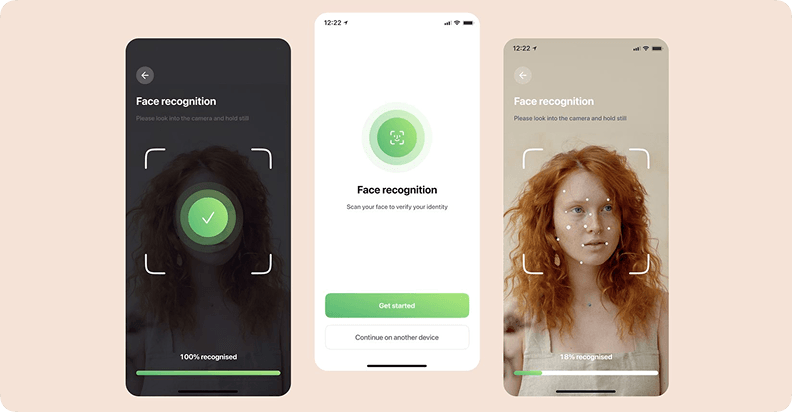
Biometric liveness and injection-attack detection — id with liveness confirms a live, present player matching the document — closing the exact gap that let drawn-on disguises and synthetic 3D models defeat face-only checks elsewhere in 2026.
Risk signal enrichment — device and account-history signals flag when a face, document, or device has already been used to register under a different declared identity, a core multi-accounting and bonus-abuse signature.
Automated decisioning — fast pass/review/decline routing, since a slow check at registration is a lost signup.
Ongoing re-verification — video verification software escalates borderline or high-risk accounts, and identity confidence is revisited if later behavior looks inconsistent with the original registration.
The two public failures earlier in 2026 both stopped at step 4 using a single frame. An operator running all seven steps has a document, a live match, and a fraud-pattern check backing up the age estimate — not just the estimate itself.
False Positives
Overcorrecting into an aggressive verification gate risks the same backlash both public failures generated — legitimate adult players misclassified and locked out, at exactly the moment a competitor's smoother registration is one tab away. The fix is a better-layered check across all seven steps, not a stricter single gate.
Business Impact
Reduced risk of the exact public spoofing pattern that embarrassed two major platforms in the same quarter of 2026.
Age and identity verification that can survive a licensing review, not just a marketing claim.
Fewer legitimate players locked out by single-frame misclassification.
Reduced multi-accounting and bonus-abuse risk caught at step 5, before the first bonus is claimed.
How Finchecker Solves It
Finchecker's igaming identity verification pairs document authentication with genuine liveness and injection-attack detection, so age and identity checks don't depend on a single facial frame the way both of 2026's public failures did. Video verification adds an escalation layer for higher-risk registrations.
Don't let your age and identity checks fail the way two major platforms' did, in public, in the same quarter. See how Finchecker handles it for iGaming.